For a long time, I lived with a quiet question that followed me everywhere – am I making my own choices, or is something already decided for me?
Some people I met believed everything is written. “Whatever is meant to happen will happen,” they would say. Others believed the complete opposite – that we are fully in charge of our lives, and destiny is just an excuse. Both sides felt sincere. Both sides felt incomplete.
I spent nearly ten years sitting with this question. Reading, reflecting, watching my own life – the unexpected blessings, the losses I didn’t see coming, the moments where no effort seemed to change anything. Slowly, through all of that, something became clearer. And the greatest clarity came not from any lecture or debate, but from quietly reading the Bhagavad Gita.
What I Came to Understand
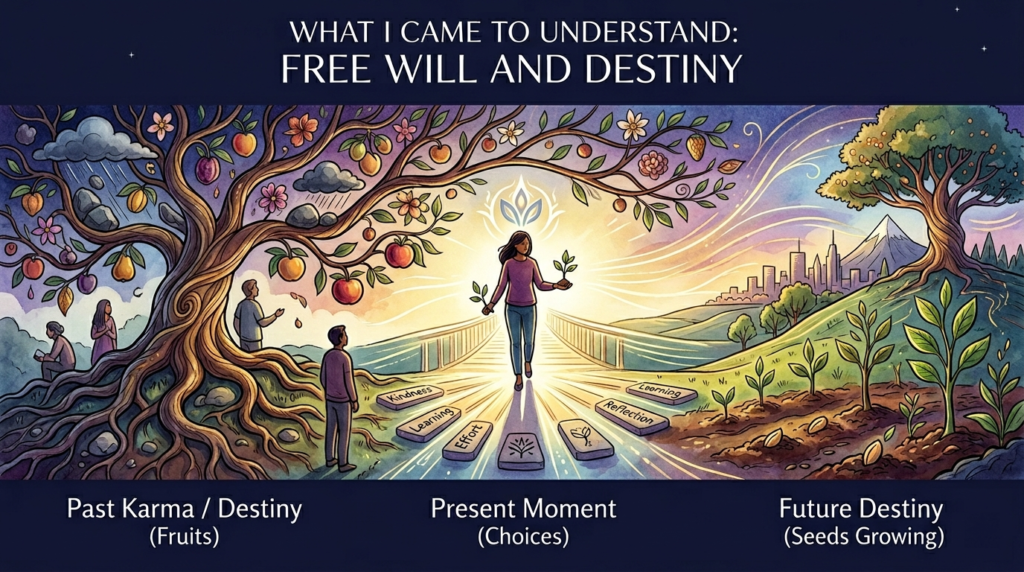
Free will and destiny are not opposites. They work together.
Our current destiny is the result of our past actions – our karma. The situations we find ourselves in, the opportunities that arrive or don’t arrive, the challenges that seem to find us – these are not random. They are fruits of seeds planted earlier, across many lifetimes.
But right here, in this present moment – we have free will. Every choice we make today is quietly creating our future destiny. The karma we plant now will bear fruit later – sometimes in this very life, sometimes many lives from now. This is the cycle.
A Simple Example – Across Lifetimes
A Simple Example – Across Lifetimes
This is the example that made it truly real for me.
Imagine a person who, in one of their lifetimes, steals one million dollars from the company they work for. No one forced them. They chose it with full awareness. This is free will.
Now the law of karma registers this. A consequence will come. But, and this is the important part – the punishment itself requires preparation.
Think about it. To face the consequence of stealing one million dollars, that person must first be in a position to have one million dollars. And to reach that position honestly, through a real business or career, many things need to work in their favor, good timing, the right opportunities, the trust of others, and the right skills. None of that comes for free. That kind of fortune is built through good actions, through good karma accumulated across many lifetimes.
So, across 51 lifetimes, this person has been doing good work, building good karma, living with effort and honesty in various ways. Those good deeds are quietly accumulating, like interest in an account.
Then comes the 52nd birth.
In this life, their good fortune finally ripens. A business opportunity arrives at the right time. Things fall into place in a way that feels almost blessed. They build the business, they work hard, and they earn that money, honestly, legitimately. This is the fruit of 51 lifetimes of good karma coming through.
But now, the other karma has also been waiting.
The bad action from that earlier life, the theft, has been patient. And now that the person has the money, the law of nature begins to create situations: a wrong business decision, a sudden crisis they couldn’t predict. One by one, circumstances arise – not by accident, but by the quiet precision of karma – until that money is gone.
The person may look around and say, “Why did this happen to me? I worked so hard.” And the person did work hard. But the loss was not a punishment for this life’s work. It was the delayed consequence of a free will choice made many lifetimes ago, finally being settled.
This is what destiny looks like – not something imposed from outside, but something that grew slowly and patiently from their own past choices.
The Cycle – And an Honest Question
Here is something I have genuinely observed, and maybe you have too.
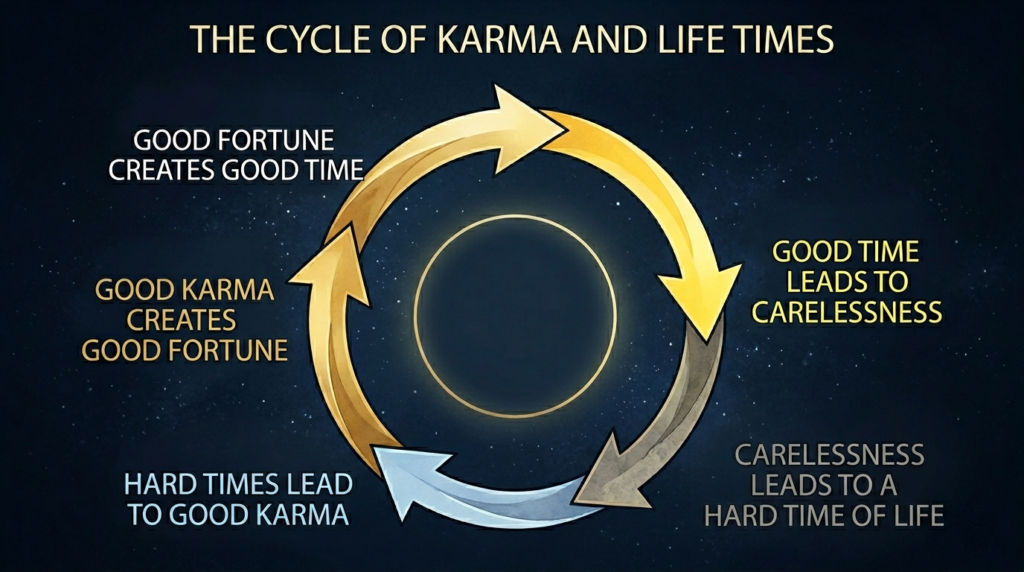
Many people with good fortune – a comfortable life, resources, opportunities – end up doing wrong things with it. Bad karma builds. Life becomes difficult. In hardship, people often do good – they become humble, they help others, they act with more care. Good karma builds. Life improves again. And then in comfort, the cycle risks repeating.
Good karma leads to a good life. A good life sometimes leads to carelessness. Carelessness builds bad karma. Bad karma brings difficulty. Difficulty brings good action. And round and round it goes – across lifetimes.
So the honest question is – what is the point? If good and bad keep cycling endlessly, what should one actually do?
What the Gita Taught Me
The Bhagavad Gita, Chapter 2, Verse 56 gave me a real answer to this.
It speaks of a person of steady mind – someone who is not shaken by sorrow, not chasing after pleasure, and free from attachment, fear, and anger. This is not someone who has escaped life. This is someone who has understood it deeply enough to stop being endlessly tossed around by it.
Real freedom is not about creating perfect karma. It is about rising above the constant reaction cycle altogether – not swinging between “life is good, let me enjoy recklessly” and “life is hard, let me just survive.” But living with steadiness, doing your duty, and not being enslaved by results either way.
This is how one slowly steps out of the endless loop.
And Then There Is Surrender
Chapter 18, Verse 66 of the Bhagavad Gita carries perhaps the most tender promise in the entire text. Shri Krishna says – surrender completely to me, and I will free you from all the reactions of your karma. Do not fear.
The one who truly surrenders does not stop working. They work – but for something larger than themselves. And what I have seen is this: the path of such a person may first look difficult. Things may not go smoothly. From the outside, it may even look like things are falling apart.
But in the end – they drink nectar.
Life, which once felt like an endless swing between good times and bad, becomes something quieter and deeper. The duality slowly loses its grip. There is a peace that no circumstance can fully take away. This is liberation – not from life itself, but from being endlessly ruled by it.
A Word for the Difficult Days
I want to say something gently here, for anyone reading this who is going through something very heavy.
When life becomes painful enough, the mind sometimes thinks there is no way forward. That darkness is real, and it makes sense that you feel it. But choosing to end your life is not destiny. It is a free will choice made in a moment of unbearable pain – and like all choices, it carries its own weight forward into the next chapter.
What I want to offer instead is this – the suffering you feel right now is temporary. Karma is not finished with you in a good way yet. The good seeds you have planted across your lifetimes are still waiting to ripen. Please stay. Talk to someone. Give the next chapter a chance to unfold.
So – What Should You Do?
Focus on your actions today. Not because results will come immediately – they may not, and some may not even come in this lifetime. But every good action is a seed. Every moment of honesty, care, and genuine effort is being recorded by a law that does not forget.
Stop blaming fate for what is difficult. Some of it was shaped by choices made long before this life. But your present self is creating tomorrow – and the lifetime after that.
And if you feel called to it – surrender to something greater. Trust that there is a wisdom at work that sees far more than we can see in any single moment.
Do your duty. Act with goodness. Release the need to control every outcome.
That, the Gita has shown me, is enough. It has always been enough.